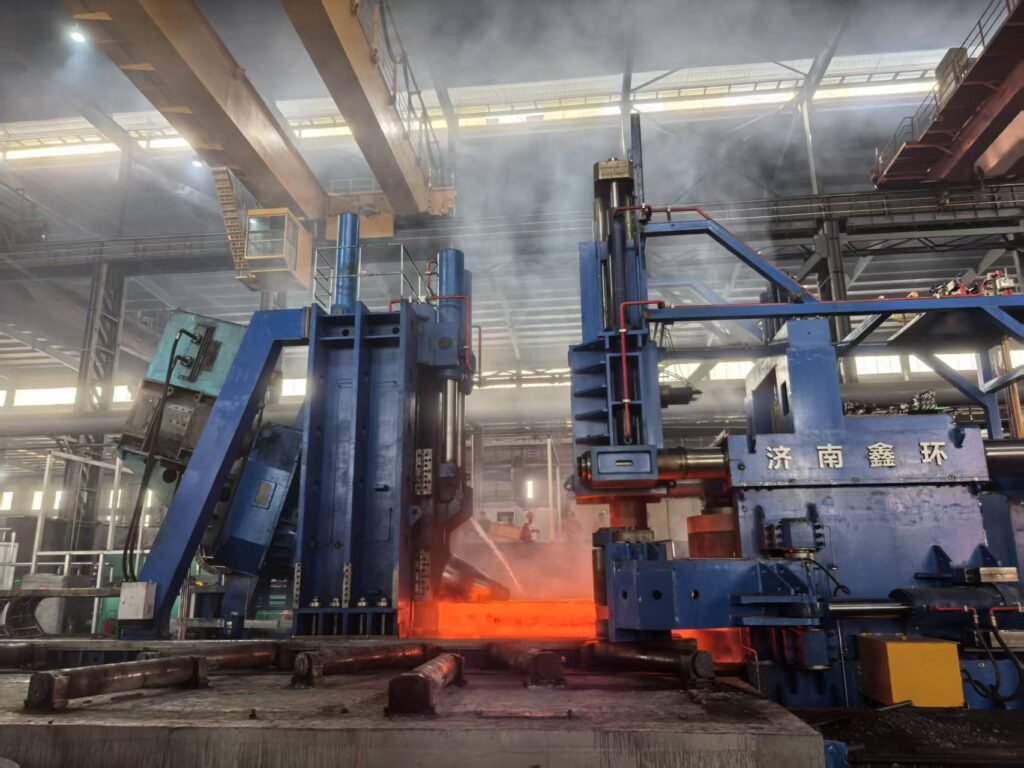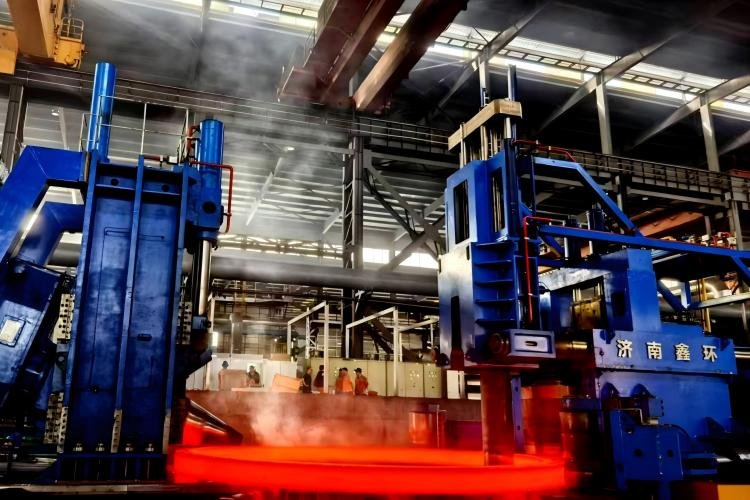
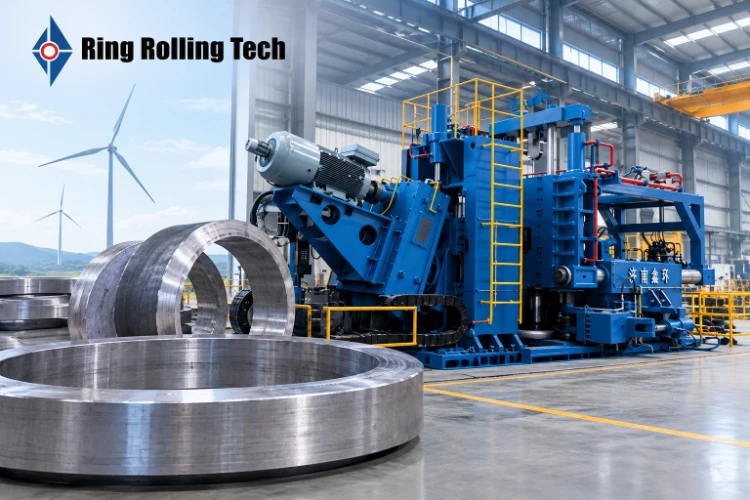
Large wind power forgings do not forgive vague equipment selection. A machine may look powerful on paper. Yet, it can still miss your actual ring dimensions, material, or production targets. We believe the better approach starts with the finished forging, not the machine catalog.
The wind industry uses large forged rings for several critical applications. These include tower flanges, yaw bearing rings, pitch bearing rings, main shaft components, and gearbox-related rings. Chinese wind turbine standards also cover rolled rings used for yaw and pitch bearings, tower flanges, main shafts, and gearbox applications.
So, how should you choose the right equipment? We suggest working backward from the finished ring. First, define the ring. Then, calculate the deformation and force requirements. Finally, match those requirements with the machine’s working range.
This method sounds simple. In practice, it prevents many expensive mistakes.
1. Start With the Wind Power Ring
When customers contact us, we prefer to see the ring drawing first. A model number alone tells us very little. A finished ring tells us where the real engineering problem begins.
A wind turbine ring forging can have a large diameter and substantial weight. Its cross-section may also change during rolling. Therefore, we need more than one dimension before selecting equipment.
Identify the Finished Ring Dimensions
At minimum, collect these values:
- Outside diameter (OD), mm
- Inside diameter (ID), mm
- Ring height (H), mm
- Wall thickness (T), mm
- Finished weight, kg or t
- Cross-section shape
- Material grade
- Required machining allowance
- Production quantity
- Dimensional tolerances
For example, consider a hypothetical ring with an OD of 6,000 mm. Its ID could reach 5,200 mm, while its height may reach 500 mm. If the finished weight approaches several tonnes, the machine needs far more than simple diameter capacity.
The cross-section also matters. A flat ring behaves differently from a stepped or profiled ring. Therefore, we never recommend choosing equipment from OD alone.
The United States Department of Energy previously documented large wind forged rings for yaw bearings, pitch bearings, main bearing applications, and tower flanges. Its industry analysis showed that ring diameters can reach several metres in major wind applications.
That is the first lesson: large diameter does not automatically mean the same machine configuration.
2. Match Machine Size to Ring Size
After defining the product, we move to the machine’s working envelope. This step sounds obvious. Surprisingly, it often causes confusion.
A supplier may advertise a maximum diameter. However, that number does not tell the entire story. We also need to consider ring height, wall thickness, billet dimensions, tool geometry, and available rolling force.
Compare OD, ID, Height, and Weight
A useful selection table should include more than one parameter.
| Ring Requirement | What We Check |
| Finished OD | Maximum rolling diameter |
| Finished ID | Minimum practical diameter |
| Ring height | Axial working range |
| Wall thickness | Radial deformation capability |
| Ring weight | Machine loading capacity |
| Cross-section | Tool and process compatibility |
| Material | Required forming force |
| Production volume | Cycle and automation requirements |
For example, a machine designed for Ø2,000–3,000 mm rings may not suit a Ø6,000 mm wind tower flange. The diameter gap alone makes the comparison difficult.
Large radial-axial systems can reach very high force levels. Publicly listed examples show radial forces from hundreds of kN to more than 10,000 kN. Axial forces can also reach several thousand kN on larger models.
These figures show why buyers should compare the complete specification. One impressive number rarely tells the whole story.
We also recommend leaving a reasonable engineering margin. A machine should not operate at its theoretical limit for every production cycle. That is like driving a truck uphill with the accelerator permanently against the floor. It works until it doesn’t.
3. Calculate Radial and Axial Rolling Requirements
Large wind power rings often require coordinated deformation. Radial rolling reduces wall thickness while increasing diameter. Axial rolling controls ring height and the cross-section.
This combination becomes especially important for large flanges and bearing rings. Research on large-scale ring rolling shows that coordinated radial-axial feed can improve geometric accuracy and reduce instability during forming.
Check Radial Force and Axial Force
We normally separate the main forming requirements into two directions:
Radial direction
- Reduces wall thickness
- Expands ring diameter
- Controls radial deformation
- Requires sufficient radial force
Axial direction
- Controls ring height
- Shapes end faces
- Controls axial spread
- Requires sufficient axial force
The exact force depends on several variables. These include material strength, temperature, cross-section, reduction schedule, ring diameter, and deformation speed.
For a wind turbine ring, material selection can significantly change the forming requirement. Commercial forging suppliers list materials such as S355NL, S420NL, 42CrMo4, 34CrNiMo6, and 30CrNiMo8 for wind applications.
Therefore, we do not treat force as a fixed number. We calculate it against the actual production case.
For buyers, the important question is not simply:
“How many tons can the machine roll?”
A better question is:
“Can this machine roll my specific ring, material, cross-section, and production schedule?”
That difference matters.
4. Consider Material and Forging Temperature
Wind power rings often combine large dimensions with demanding mechanical requirements. The equipment must therefore work reliably with the selected steel grade and forming temperature.
The material affects deformation resistance. Temperature affects flow stress. Meanwhile, the reduction schedule affects how the material moves through the deformation zone.
Review Material, Heat, and Deformation
Before selecting equipment, we recommend preparing:
- Material grade
- Chemical composition
- Initial billet temperature
- Target forging temperature range
- Heating method
- Initial billet dimensions
- Required reduction
- Target deformation ratio
- Cooling method
- Heat-treatment route
A Chinese specification published as GB/T 44508-2024 covers wind turbine ring forgings. It addresses steel, melting and refining, forging and rolling, deformation ratio, heat treatment, mechanical properties, internal quality, ultrasonic testing, dimensional tolerances, and machining allowances.
That list tells us something important. The rolling step cannot operate as an isolated process.
The final ring depends on the complete manufacturing route. Material preparation, heating, forging, rolling, heat treatment, inspection, and machining all connect.
A historical Chinese patent for large wind turbine bearing rings also describes a sequence involving billet preparation, heating, forging, re-forming, ring expansion, rolling, cutting, and heat treatment. The disclosed process used 42CrMo4 for the bearing ring application.
So, when we discuss equipment, we also ask what happens before and after rolling. The machine should fit the production line, not sit in the middle like an expensive island.
5. Look Beyond Maximum Diameter
Maximum diameter gets attention because it is easy to understand. Yet, other specifications often determine whether production runs smoothly.
For wind power forgings, we pay close attention to force, control, accuracy, tooling, drive power, and automation. We also examine how the machine handles changing ring dimensions.
Check CNC Control and Process Stability
Large rings require controlled deformation. The operator must manage several variables while the ring grows in diameter.
A modern CNC system can help coordinate:
- Radial feed
- Axial feed
- Rolling speed
- Ring diameter
- Roller position
- Reduction rate
- Process limits
- Alarm functions
This becomes more important as the ring size increases. A small error can become a large dimensional deviation after many rolling passes.
Process stability also matters for repeat production. A buyer may produce one successful trial ring. That does not automatically prove stable production over 100 or 1,000 rings.
We therefore recommend asking for production evidence. Look for similar ring sizes, similar materials, similar cross-sections, and similar weights.
Do not ask only for photographs. Ask for parameters.
For example:
| Parameter | Example Requirement |
| Finished OD | 6,000 mm |
| Finished ID | 5,200 mm |
| Height | 500 mm |
| Ring weight | 8,000 kg |
| Material | 42CrMo4 |
| Radial force | Project-specific |
| Axial force | Project-specific |
| Production volume | 300 pcs/year |
| Control | CNC |
| Process | Radial + axial rolling |
This makes supplier comparison much more meaningful.
6. Understand the Wind Power Ring Forging Market
The wind sector creates demand for several categories of large forged rings. However, the applications do not all have identical requirements.
The wind turbine ring forging market includes components for towers, bearings, shafts, gear systems, and other structural assemblies. Market research also separates wind turbine forging into open-die forging, seamless rolled rings, and closed-die forging.
Separate Flanges From Bearing Rings
Tower flanges primarily connect structural sections. Bearing rings perform a different mechanical role and face different contact and fatigue requirements.
Wind power flanges therefore require strong dimensional control. Bearing rings may require even tighter control over raceway-related machining allowances and geometry.
A typical application list includes:
- Tower flange rings
- Yaw bearing rings
- Pitch bearing rings
- Main bearing rings
- Gear rings
- Gearbox-related rings
- Other large structural rings
FRISA also identifies flanges, bearings, gears, couplings, and main shaft forgings among wind power applications. It lists several low-alloy and alloy steels used across these applications.
This distinction matters when selecting equipment.
For example, a machine optimized for large flat flanges may not automatically provide the best solution for every bearing ring. The cross-section and deformation route can change the engineering requirement.
The phrase china ring forging for wind power flange may attract buyers searching for Chinese suppliers. However, buyers should still compare technical capability rather than country alone.
We believe the better question is simple:
Can the supplier prove that its equipment matches your ring?
7. Build a Practical Selection Checklist
At this stage, the selection process becomes much easier. We start with the product. Then we match the forming process. Finally, we verify the supplier.
Send These Data to the Manufacturer
When requesting a quotation, we recommend sending the following information:
Product data
- OD: ___ mm
- ID: ___ mm
- Height: ___ mm
- Wall thickness: ___ mm
- Weight: ___ kg
- Cross-section drawing: Yes / No
- Material: ___
- Quantity: ___ pcs/year
Process data
- Starting billet OD: ___ mm
- Starting billet ID: ___ mm
- Starting height: ___ mm
- Billet weight: ___ kg
- Forging temperature: ___ °C
- Target reduction: ___ %
- Heat treatment: ___
- Machining allowance: ___ mm
Quality requirements
- Dimensional tolerance
- Roundness
- Flatness
- Surface condition
- UT requirements
- MT requirements
- Mechanical properties
- Applicable standard
Equipment requirements
- Maximum OD
- Maximum ring height
- Radial force
- Axial force
- Main motor power
- CNC control
- Automation level
- Tooling configuration
- Installation requirements
This information lets a manufacturer evaluate the application instead of guessing.
It also makes quotations easier to compare. Otherwise, two suppliers may quote different configurations for what appears to be the same project.
That creates a familiar purchasing headache. The cheaper quote may simply include less equipment.
Conclusion: Select From the Ring Backward
Selecting equipment for large wind power forgings should not begin with a machine model. It should begin with the finished ring.
First, define OD, ID, height, wall thickness, weight, material, and cross-section. Next, evaluate radial force, axial force, deformation, temperature, tooling, and process control. Finally, compare the supplier’s experience with similar large rings.
For ring rolling machine for wind power applications, maximum diameter is only one part of the decision. Force capacity, axial control, CNC performance, process stability, and production volume deserve equal attention.
The same principle applies when evaluating china ring forging for wind power flange suppliers. A supplier should provide more than a catalog. It should explain how its equipment matches your product and production route.
At Shandong Ring Rolling Tech, we prefer to start with your ring drawing and production data. We can then work backward toward the required equipment configuration.
That approach takes a little more effort at the beginning. In our experience, it saves much more effort later.
And with large wind power forgings, “later” is usually the expensive part.