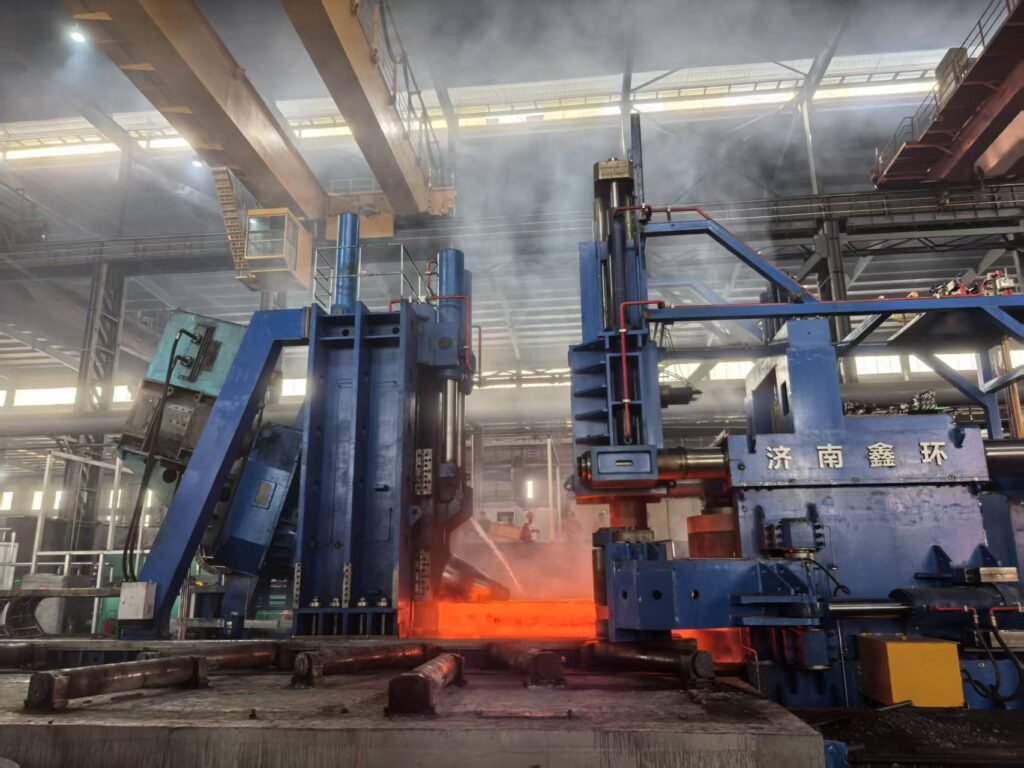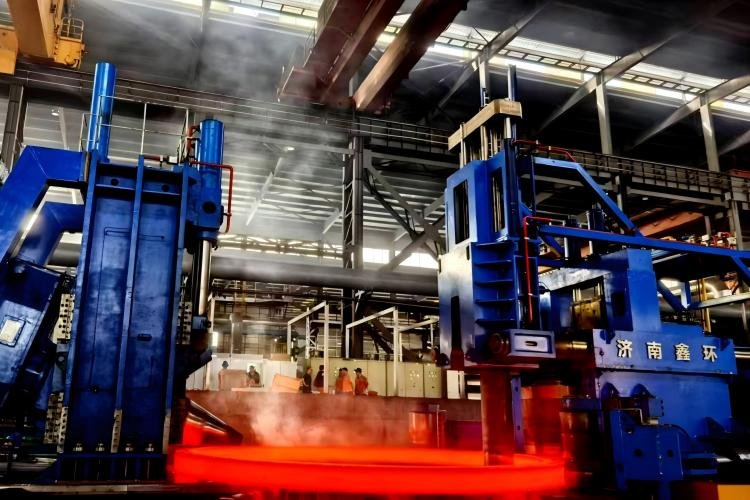
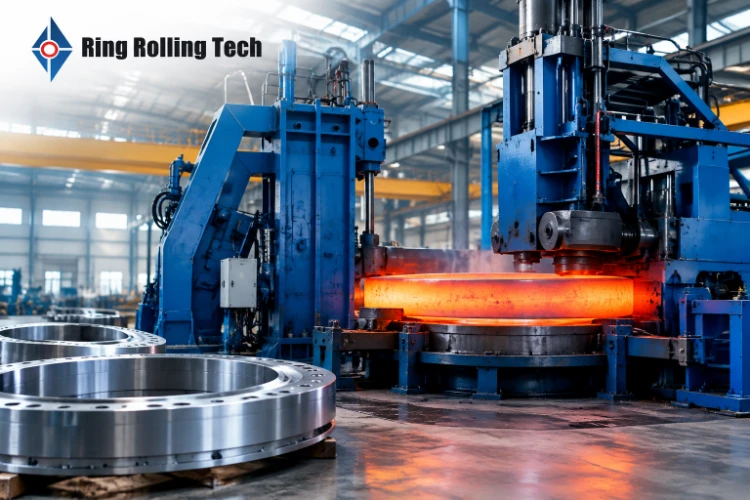
Large-diameter flanges look simple. In reality, they can be demanding forging components. We often see buyers focus on maximum diameter first, but that number tells only half the story. Our approach starts with the finished flange, material, section profile, and production target.
Why Large Flanges Need Careful Rolling
A flange ring rolling machine must handle more than diameter growth. The process also controls wall thickness, ring height, profile accuracy, and deformation stability. For example, a project may involve a ring such as Ø2,500 × Ø2,100 × 180 mm, with a final weight above several hundred kilograms.
Start With the Finished Ring
We recommend collecting these parameters before selecting equipment:
- Finished OD and ID: mm
- Ring height: mm
- Cross-section: rectangular, tapered, stepped, or profiled
- Material grade and forging temperature
- Finished weight: kg
- Annual output: pcs/year
- Required dimensional tolerance: ±mm
This information gives us a much clearer starting point. The machine should fit the forging, not the other way around.
Key Equipment Parameters
Large flange production requires stable radial deformation and accurate control. The drive roll, mandrel system, axial rolls, motor power, and control system must work together. The Forging Industry Association notes that ring rolling reduces wall thickness while increasing diameter, while producing seamless rings with forged properties.
Radial and Axial Control
For a typical ring, radial rolling changes the wall thickness and diameter. Axial control helps maintain ring height and end-face geometry. Therefore, we check parameters such as maximum OD, minimum ID, maximum height, radial force, axial force, rolling speed, and motor power before recommending a configuration.
Material Changes the Equation
Steel grades do not behave identically during hot deformation. Carbon steel, alloy steel, and stainless steel can require different heating and rolling conditions. This matters especially for china flange ring forgings, where material grade, blank size, and final application may vary significantly.
Heat Treatment Is Part of the Plan
Rolling creates the ring shape, but the process does not end there. Heat treatment can strongly affect hardness, strength, toughness, and dimensional stability. ASTM A182/A182M-26 covers forged or rolled alloy and stainless steel flanges and specifies requirements involving cooling and heat treatment.
Think Beyond the Rolling Pass
We usually consider the complete route:
Billet → Heating → Upsetting & Piercing → Ring Rolling → Cooling → Heat Treatment → Machining → Inspection
That sequence helps us avoid a common mistake: selecting equipment only from the final diameter. A large ring may require substantial deformation before reaching its finished dimensions.
Why Seamless Forging Matters
Ring rolling creates a continuous circumferential grain-flow structure. This structure can support demanding applications such as pressure equipment, wind-power components, heavy machinery, and large piping systems. ASME B16.47, for example, covers large-diameter steel flanges from NPS 26 to NPS 60, including materials, dimensions, tolerances, marking, and testing.
Build the Specification Backward
We prefer a simple rule: start with the finished forging and work backward. Define the ring size, profile, material, weight, tolerance, and output first. Then we match the forming process and equipment capacity.
For us, good equipment selection is not about choosing the biggest machine. It is about choosing a machine that fits the real job without leaving expensive capacity sitting idle.