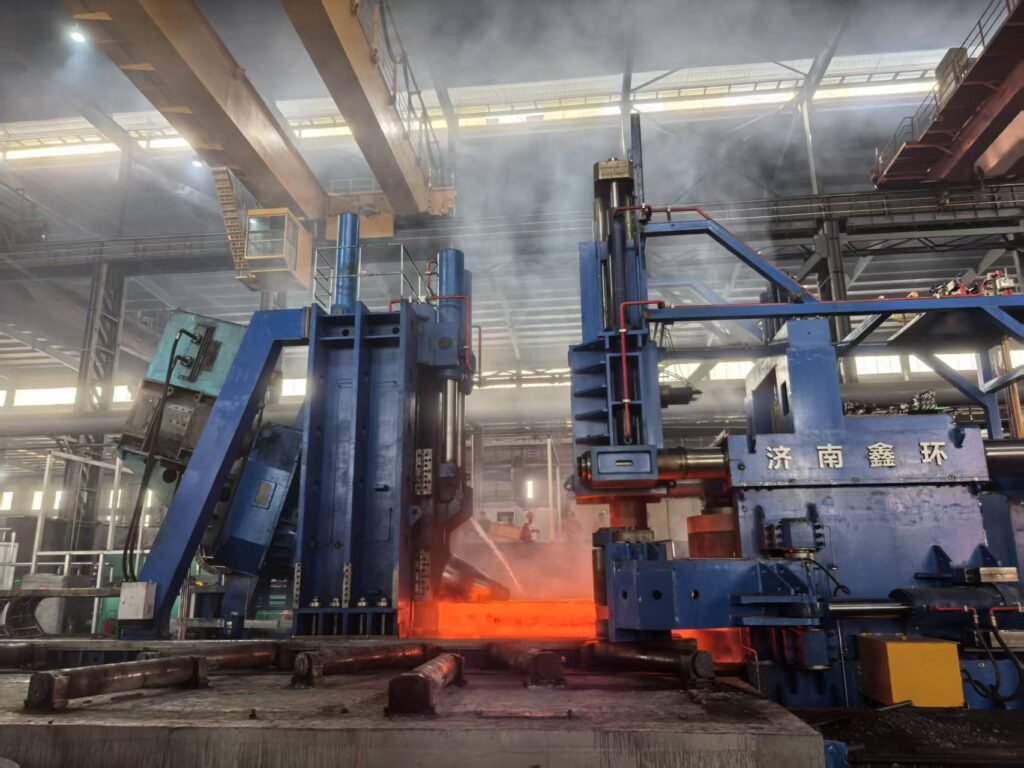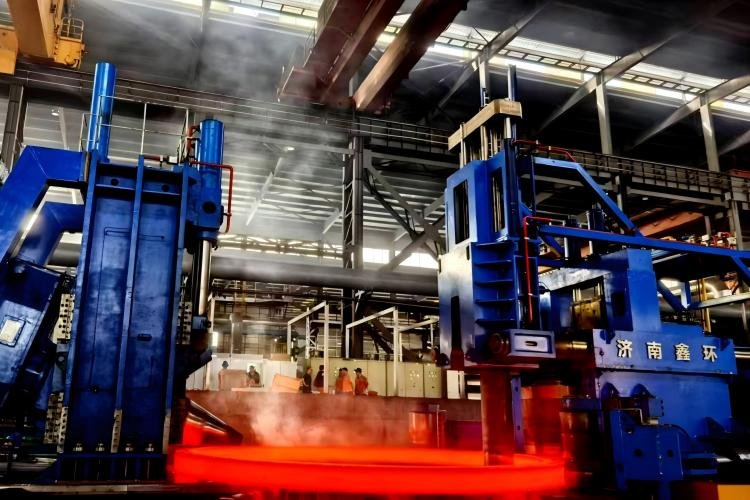
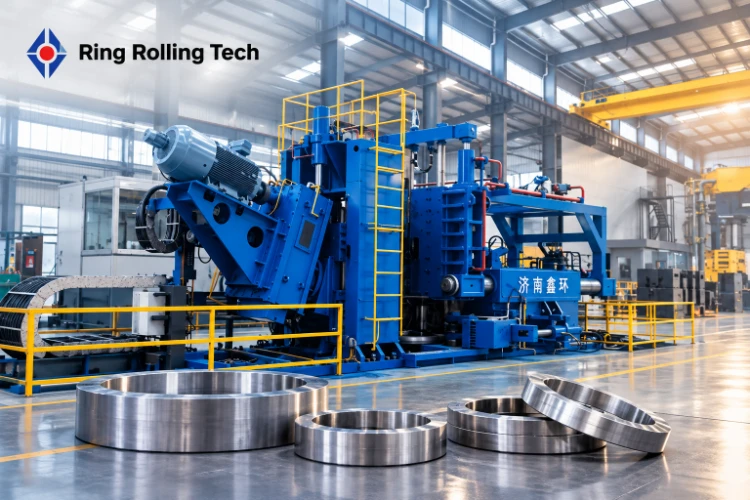
Buying forging equipment can feel like ordering a suit from a catalog. The number looks right, but the fit can still be wrong. We believe the same principle applies when you buy a ring rolling machine for long-term production.
The best starting point is not the model name or advertised capacity. Start with the ring you need to produce. Its size, shape, cross section, material, weight, and annual output will guide the final equipment specification.
1. Start With the Finished Ring
Define ring sizes before machine capacity
We first ask for the finished ring dimensions. Typical data includes outside diameter (OD), inside diameter (ID), height, wall thickness, and finished weight. For example, a ring may measure Ø1,500 mm × Ø1,200 mm × 180 mm.
Do not stop at diameter. A 20 mm wall section behaves very differently from a heavy cross section. The same OD can require very different forming forces, tooling, and process control.
A useful starting table looks like this:
| Parameter | Example |
|---|---|
| Outside diameter | 1,500 mm |
| Inside diameter | 1,200 mm |
| Height | 180 mm |
| Wall thickness | 150 mm |
| Material | Stainless steel |
| Finished weight | 850 kg |
| Annual output | 2,000 pcs |
This information gives us a much clearer picture than simply asking for a “large machine.”
2. Check the Cross Section and Shape
Rectangular rings are only the beginning
Ring geometry strongly affects the forming strategy. Simple rectangular rings usually present fewer challenges than stepped, tapered, T-shaped, L-shaped, or other profiled sections.
We also check whether the customer needs one fixed geometry or several types of rings. A flexible production line may need wider tooling and a broader process window.
Consider these factors:
- Rectangular or profiled cross section
- Constant or variable wall thickness
- Symmetrical or asymmetrical profile
- Flat or stepped end faces
- Standard or custom ring sizes
- Required machining allowance
Near-net-shape production can reduce later machining. However, it also demands better control of geometry during rolling.
Why geometry matters
The ring rolling process gradually changes the cross section while increasing the ring diameter. Radial deformation mainly reduces wall thickness, while axial deformation controls ring height.
That means size and shape cannot sit in separate boxes. They interact throughout the forming cycle.
3. Match the Process to the Material
Stainless steel is not just another steel
Material selection changes the equipment requirements. Carbon steel, alloy steel, stainless steel, titanium alloy, and high-temperature alloys can behave differently during hot deformation.
We normally review:
- Yield strength
- Flow stress
- Forging temperature
- Deformation resistance
- Thermal conductivity
- Required reduction
- Final mechanical properties
For aerospace applications, material control becomes even more important. Rings used around a jet engine, for example, may require strict process control and traceability.
A buyer should therefore provide the material grade whenever possible. “Steel” is useful. “17-4 PH stainless steel” is much better.
4. Choose Radial, Axial, or Both
Understand radial and axial deformation
Pure radial rolling focuses on reducing the ring wall while increasing diameter. Radial and axial rolling adds axial rolls to control the ring height and end-face geometry.
For many large seamless rings, axial control becomes important. Research on radial-axial forming shows that axial roll movement can strongly influence process stability and ring quality.
This is why axial ring rolling machines and radial-axial systems deserve careful comparison. The correct configuration depends on your ring dimensions, cross section, material, and production target.
D53K is a model family, not a complete answer
Buyers often search for D53K when comparing equipment. It can help identify a radial-and-axial configuration, but the model name alone does not define your final machine.
We recommend checking the actual working range behind the model:
- Maximum and minimum ring OD
- Maximum ring height
- Minimum wall thickness
- Maximum rolling force
- Maximum rolling torque
- Main roll speed
- Axial roll speed
- Guide roll control
- CNC or digital control functions
- Measurement and feedback systems
A model number starts the discussion. Your production data finishes it.
5. Compare the Numbers That Affect Production
Capacity is more than maximum diameter
A common mistake is to compare suppliers only by maximum ring size. Maximum OD looks impressive on a brochure, but it may not tell you how efficiently the machine produces your actual rings.
We suggest comparing at least these parameters:
| Specification | Why it matters |
|---|---|
| OD range | Defines workable ring sizes |
| Height range | Controls axial product flexibility |
| Wall thickness range | Defines deformation capability |
| Maximum force | Handles difficult materials and sections |
| Maximum torque | Supports heavy-duty rolling |
| Roll speed | Influences cycle time |
| Feed rate | Affects deformation stability |
| Control accuracy | Supports high precision |
| Measuring system | Improves dimensional consistency |
| Installed power | Affects production and energy use |
For high productivity, cycle time matters as much as maximum capacity. A machine that spends less time on setup, measurement, and adjustment can produce more useful parts over a year.
Do not ignore heavy-duty operating conditions
Heavy equipment needs stable mechanical structures. It also needs suitable hydraulic, electrical, lubrication, cooling, and control systems.
We always recommend asking how the supplier defines its rated capacity. “Maximum force” without application conditions can create an apples-to-oranges comparison.
6. Turn the Data Into a Final Specification
Build the specification backward
Once we know the finished ring, we work backward through the manufacturing route. The process may include heating, upsetting, piercing, preforming, rolling, heat treatment, and machining.
The final specification should connect these stages. It should not exist as an isolated equipment list.
For a serious RFQ, we recommend providing:
- Finished ring dimensions
- Blank dimensions
- Material grade
- Forging temperature range
- Required reduction
- Ring weight
- Production quantity
- Target cycle time
- Dimensional tolerances
- Cross-section drawings
- Machining allowance
- Existing upstream equipment
- Required automation
- Factory power conditions
- Quality and inspection requirements
This approach helps ring rolling machine manufacturers understand the application before preparing a quotation.
Compare suppliers on engineering support
When comparing ring rolling machine manufacturers in China, price should not stand alone. The same applies when researching a ring rolling machine for sale or comparing a ring rolling machine price in India with offers from ring rolling machine manufacturers in India.
Ask what each supplier includes. Check tooling, installation, commissioning, operator training, software, spare parts, documentation, warranty, and after-sales support.
A low initial price can look attractive. Long-term production costs tell the bigger story.
7. Make the Final Decision With Real Data
Use the ring as the final test
Before selecting equipment, we recommend testing your most demanding ring. Do not use only the easiest product in your portfolio.
Consider the largest OD, smallest wall section, highest-strength material, heaviest blank, and most complex cross section. If the equipment handles that combination comfortably, your normal production range becomes much easier to manage.
The goal is not simply producing seamless rings. The goal is producing them repeatedly, accurately, and economically.
Think beyond the purchase date
A forging machine should support your production plan for the long term. Future ring sizes, new materials, automation requirements, and higher output can quickly expose a narrow specification.
At Shandong Ring Rolling Tech, we prefer to discuss the finished product first. Then we match the process, machine structure, control system, tooling, and production targets.
That conversation may take a little longer at the beginning. In our experience, it saves much more time later.
The smartest buying decision rarely starts with “How much does it cost?” It starts with a better question: What exactly do you need to produce?