Buying a large forging machine rarely starts with a simple question. Most buyers ask for capacity, price, and delivery first. However, the specification sheet usually tells the deeper story. A machine may look impressive on paper yet miss the requirements of your actual ring products.
At Shandong Ring Rolling Tech, we believe buyers should start with the finished ring. Then, work backward through the blank, material, deformation, forces, and production targets. This approach makes ring rolling equipment selection much more practical. It also prevents an expensive mistake: buying capacity you cannot use.
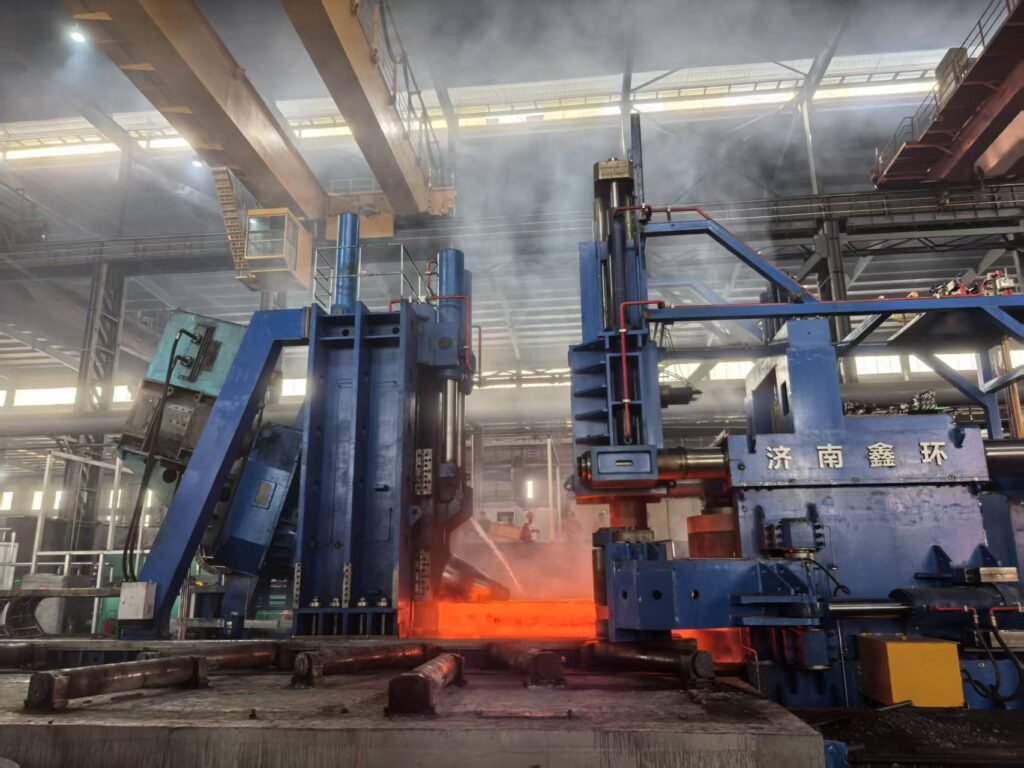
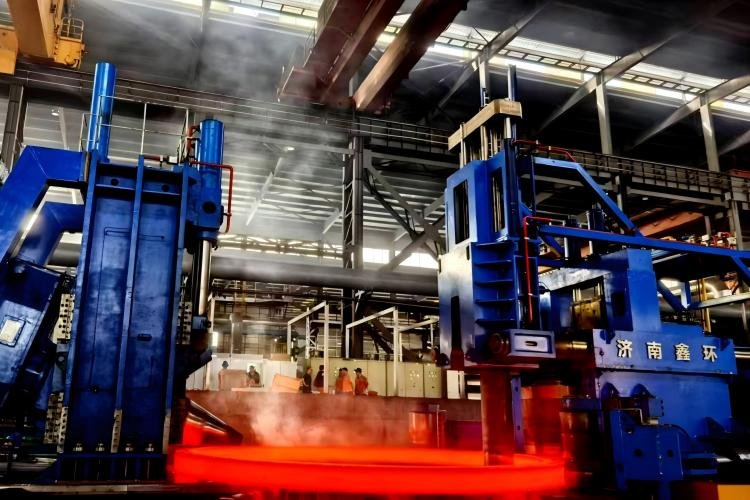
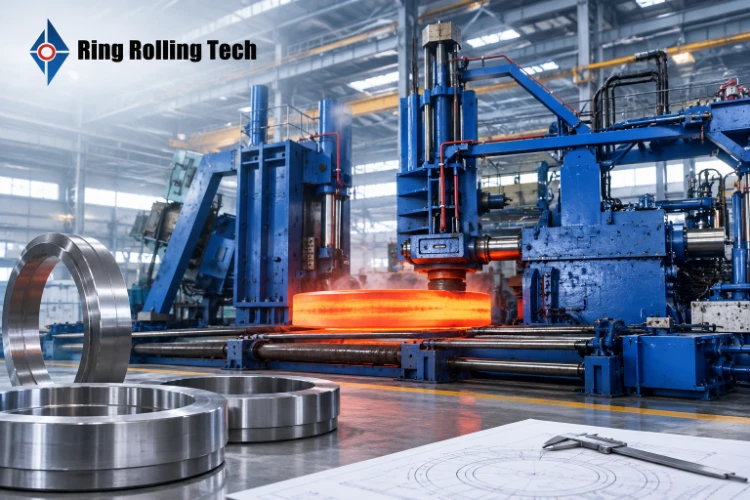
A radial axial machine combines two deformation directions during the process. Radial rolling reduces wall thickness while increasing diameter. Axial rolling controls the ring height and end-face geometry. Together, these movements create a more flexible forming process for many seamless forged rings.
This guide explains the specifications we recommend comparing before requesting a quotation. We will focus on the numbers that actually affect production.
1. Start With Ring Size, Not Machine Size
The first specification should always match your product range. Buyers often compare machines by model number alone. That shortcut can create trouble because different manufacturers define their models differently.
A D53K-2000, for example, may indicate a nominal maximum diameter. It does not automatically describe every ring size the machine can produce. The actual working range matters much more.
Maximum outside diameter
Maximum OD defines the largest finished ring diameter that the machine can accommodate. But maximum OD should never stand alone.
Check these values together:
- Minimum finished OD
- Maximum finished OD
- Minimum ring height
- Maximum ring height
- Minimum wall thickness
- Maximum wall thickness
- Maximum blank diameter
- Maximum blank height
- Maximum finished weight
A machine listed for a 2,000 mm ring does not mean every 2,000 mm ring fits. Height, wall thickness, material, and deformation requirements also influence the feasible range.
For example, one published D53K series lists working OD ranges from several hundred millimeters to more than 12,000 mm. Its ring-height ranges also expand substantially as machine capacity increases.
Ring height and cross-section
Ring height directly affects axial deformation. It also affects tool contact and process stability.
If your products include tall rings, thin rings, flanges, or complex profiles, check the height range carefully. Do not compare only the maximum number.
We recommend creating a product matrix before contacting a supplier:
| Product | OD | Height | Wall Thickness | Material | Weight |
|---|---|---|---|---|---|
| Ring A | 800 mm | 120 mm | 80 mm | 42CrMo4 | 180 kg |
| Ring B | 1,600 mm | 250 mm | 140 mm | Stainless steel | 620 kg |
| Ring C | 3,000 mm | 400 mm | 220 mm | Alloy steel | 1,850 kg |
This simple table gives the manufacturer something useful to calculate.
2. Compare Radial and Axial Rolling Forces
Force capacity sits near the heart of the specification sheet. Yet many buyers focus only on radial force. That misses half of the forming picture.
The machine must control both deformation directions. Researchers have developed analytical methods specifically to estimate radial and axial forces during the process.
Radial rolling force
Radial force controls the deformation between the main roll and mandrel. It directly affects wall-thickness reduction and diameter growth.
Manufacturers commonly express radial force in kN. For example:
1,250 kN = 1.25 MN
2,000 kN = 2.00 MN
5,000 kN = 5.00 MN
10,000 kN = 10.00 MN
Higher force does not automatically mean better production. We need enough force for the material and cross-section without paying for excessive capacity.
Axial rolling force
Axial force controls deformation along the ring height. It becomes especially important for rings with substantial height or complex cross-sections.
A typical specification sheet may show separate values such as:
- Radial force: 2,000 kN
- Axial force: 1,600 kN
- Rolling speed: 1.3 m/s
Published D53K specifications show that radial and axial capacities vary independently across models.
That difference matters. Two machines can share the same maximum OD while offering different axial capabilities.
Force matching matters more than force chasing
We always recommend matching force to actual production conditions. Material grade, deformation ratio, blank geometry, temperature, ring dimensions, and rolling strategy all affect force demand.
For hot forging applications, buyers should provide the material grade and forging temperature. The supplier can then evaluate whether the selected machine has adequate force and torque.
In other words, do not simply ask, “How many tons is the machine?” Ask, “What can it roll, at what temperature, and under what deformation conditions?”
That question produces a much better answer.
3. Check Rolling Speed and Drive Power
Force tells you whether the machine can perform the deformation. Speed and power tell you how effectively it can perform it.
Rolling speed usually appears in m/s. Some specifications provide a fixed value. Larger machines may offer a variable range.
Published examples show rolling speeds around 1.3 m/s for smaller capacities. Larger systems can use approximately 0.4–1.4 m/s variable speed ranges.
Rolling line speed
Speed affects productivity, heat retention, surface quality, and process control. Faster does not always mean better.
A ring can lose heat during rolling. If the cycle becomes too slow, the material may leave the preferred forging temperature window. If the process becomes too aggressive, force and stability can become difficult to control.
Therefore, compare:
- Minimum rolling speed
- Maximum rolling speed
- Speed regulation method
- Radial drive power
- Axial drive power
- Main motor torque
- Acceleration and deceleration
- Speed response
Motor power also increases significantly with machine capacity. Published D53K data, for example, lists radial motors from hundreds of kilowatts to multiple megawatts on larger models.
That is a useful reminder. A huge machine also brings a huge electrical infrastructure requirement.
4. Examine CNC Control and Process Automation
Modern radial axial ring rolling machine specifications should include more than mechanical numbers. The control system can strongly influence repeatability and operator workload.
A capable CNC system coordinates radial movement, axial movement, rotation, centering, and process feedback. It should also make production parameters easy to enter and monitor.
Rolling curve and automatic coordination
Some CNC systems can generate a rolling curve from the ring and blank dimensions. The system then coordinates radial and axial movement according to that curve.
This feature can reduce manual intervention. It can also improve consistency between production batches.
When comparing suppliers, ask whether the system provides:
- Automatic rolling curve generation
- Automatic radial-axial coordination
- Programmable rolling schedules
- Recipe storage
- Real-time force monitoring
- Position feedback
- Speed feedback
- Alarm history
- Production data recording
- HMI visualization
- Remote diagnostics
These functions may not appear in the headline specification. They can still make a significant difference after installation.
Measurement and feedback
A machine should know what the ring is doing, not simply move according to a preset sequence.
We recommend checking the measurement architecture. Ask how the system monitors ring diameter, roll position, force, speed, and other critical process variables.
Better feedback creates better process control. It also gives engineers useful production data for troubleshooting.
That matters when your factory moves from one ring specification to another. Nobody enjoys spending an afternoon arguing with a machine because nobody knows what happened.
5. Compare Working Range With Your Product Roadmap
Buyers should think beyond today’s order book. A machine represents a long-term production asset.
If your current largest ring measures 1,400 mm, you may not need a 5,000 mm system. But if your market strategy targets larger bearing rings, flanges, wind-power components, or pressure-vessel rings, future capacity deserves consideration.
Use the full specification range
Consider the following questions:
- What is our current maximum OD?
- What is our current minimum OD?
- What ring heights do we produce?
- What materials do we process?
- What is the heaviest ring?
- What annual output do we expect?
- What future ring sizes could enter our product line?
Then compare those answers against the machine’s working envelope.
The supplied D53K model list illustrates how dramatically capacity can expand. It includes models from D53K-1000 through D53K-12000, with some heavy-duty and flange-focused configurations. Your exact supplier configuration may differ, so always request the latest technical drawing and parameter sheet.
6. Understand the Difference Between Standard and Heavy Type
A specification table may include labels such as Standard, Heavy Type, or Flange Dedicated. Do not treat those labels as decoration.
They usually indicate different application priorities and mechanical configurations. The detailed engineering package should explain the differences.
Heavy-duty applications
Large rings can create demanding loads on the frame, rolls, drives, hydraulic systems, and bearings. Heavy-duty construction can support applications requiring higher forming forces or larger cross-sections.
Your comparison should include:
- Machine frame stiffness
- Main roll dimensions
- Mandrel dimensions
- Hydraulic capacity
- Bearing arrangement
- Drive torque
- Structural safety margin
- Cooling system
- Lubrication system
- Foundation requirements
The largest model in your list reaches a stated 16,000 kN radial force. That equals 16 MN, which puts the scale of the equipment into perspective. Published D53K data also lists 8,000 kN axial force for a 12,000-class machine.
At this scale, the foundation is not an afterthought.
7. Compare Machine Footprint and Factory Requirements
A buyer may successfully select the forming capacity and still encounter a factory problem. Large equipment needs space, foundation strength, utilities, material flow, and maintenance access.
Published specifications show overall machine lengths reaching tens of meters on large models. Width and height also increase substantially with capacity.
Check the installation envelope
Before signing an order, confirm:
- Overall length
- Overall width
- Overall height
- Working height
- Foundation depth
- Crane capacity
- Maintenance clearance
- Electrical supply
- Hydraulic station location
- Cooling-water requirements
- Material loading route
The delivery route deserves attention too. A machine that fits inside the factory may still struggle to enter the factory.
That sounds obvious. Yet large industrial equipment has a funny habit of discovering doors that are mysteriously too small.
Foundation and utilities
Ask the supplier for foundation drawings before construction begins. Do not wait until the machine arrives.
Also confirm the electrical load. Large drive motors can require substantial installed power. Your factory transformer, switchgear, cables, and cooling systems must support the planned configuration.
We recommend treating the machine and factory infrastructure as one engineering project.
8. Use This Specification Checklist Before Buying
A useful comparison sheet should put all critical parameters side by side. That makes differences much easier to identify.
| Specification | What Buyers Should Check |
|---|---|
| Model | Exact manufacturer model |
| Type | Standard / Heavy Type / Dedicated |
| Max OD | Finished ring diameter |
| Min OD | Smallest practical ring diameter |
| Ring Height | Minimum and maximum |
| Radial Force | kN or MN |
| Axial Force | kN or MN |
| Rolling Speed | m/s and adjustment range |
| Radial Motor | kW |
| Axial Motor | kW |
| CNC | Control architecture |
| Measurement | Diameter, position, force, speed |
| Automation | Automatic rolling curve and coordination |
| Machine Size | L × W × H |
| Foundation | Drawing and load requirements |
| Utilities | Power, water, hydraulics, cooling |
| Service | Installation, commissioning, training |
For your reference, the supplied model data gives the following high-level capacity sequence:
| Model | Type | Max OD | Ring Height | Radial Force |
|---|---|---|---|---|
| D53K-1000 | Standard | 1,000 mm | 250 mm | 800 kN |
| D53K-1200 | Standard | 1,200 mm | 300 mm | 1,250 kN |
| D53K-1600 | Standard | 1,600 mm | 350 mm | 1,250 kN |
| D53K-2000 | Standard | 2,000 mm | 420 mm | 1,600 kN |
| D53K-3000 | Standard | 3,500 mm | 500 mm | 2,000 kN |
| D53K-5000 | Standard | 5,000 mm | 600 mm | 2,500 kN |
| D53K-6300 | Standard | 6,300 mm | 850 mm | 4,000 kN |
| D53K-6300 | Heavy Type | 6,300 mm | 1,000 mm | 5,000 kN |
| D53K-7000 | Heavy Type | 7,000 mm | 1,200 mm | 6,300 kN |
| D53K-8000 | Heavy Type | 8,000 mm | 800 mm | 5,000 kN |
| D53K-9000 | Flange Dedicated | 9,000 mm | 1,400 mm | 8,000 kN |
| D53K-10000 | Flange Dedicated | 10,000 mm | 1,650 mm | 10,000 kN |
| D53K-12000 | Flange Dedicated | 12,000 mm | 2,200 mm | 16,000 kN |
These figures come from the specification set supplied for this article. Published industry tables show that manufacturers can define model ranges differently, so buyers should treat any table as a starting point.
Final Thoughts: Compare the Whole System
When we evaluate a ring rolling project, we never look at one number alone. OD, height, radial force, axial force, speed, motor power, control, tooling, and factory requirements all interact.
The most important lesson is simple: do not buy the biggest machine merely because the numbers look impressive. Instead, match the machine to your product range, material, deformation requirements, production volume, and future plans.
For buyers comparing radial axial ring rolling machine specifications radial axial ring rolling machine options, the right question is not simply, “Which model has the largest capacity?” The better question is, “Which configuration gives our products enough capacity, control, productivity, and room to grow?”
That approach produces a much more useful technical comparison.
At Shandong Ring Rolling Tech, we prefer to start with your actual ring drawings and production requirements. From there, we can evaluate the working range, radial and axial forces, drive configuration, CNC functions, and supporting systems. In our experience, a good specification starts with the ring—not the machine catalog.