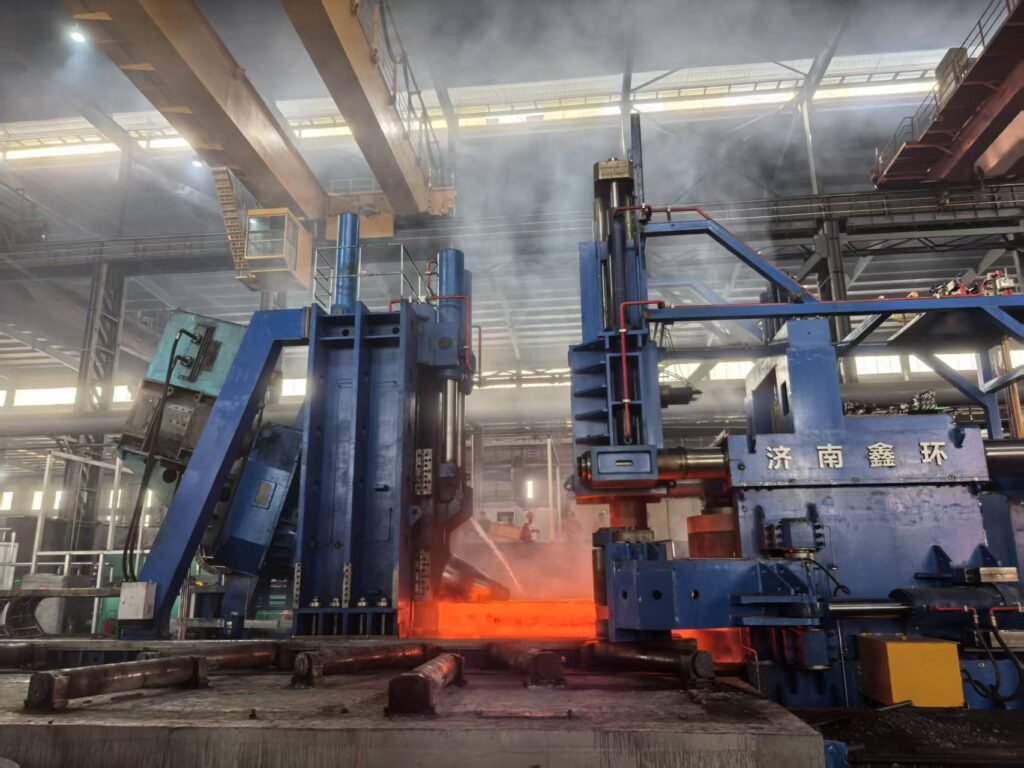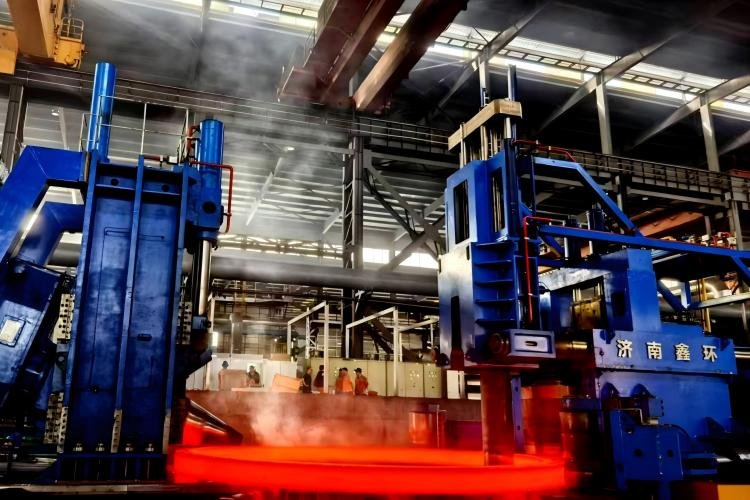
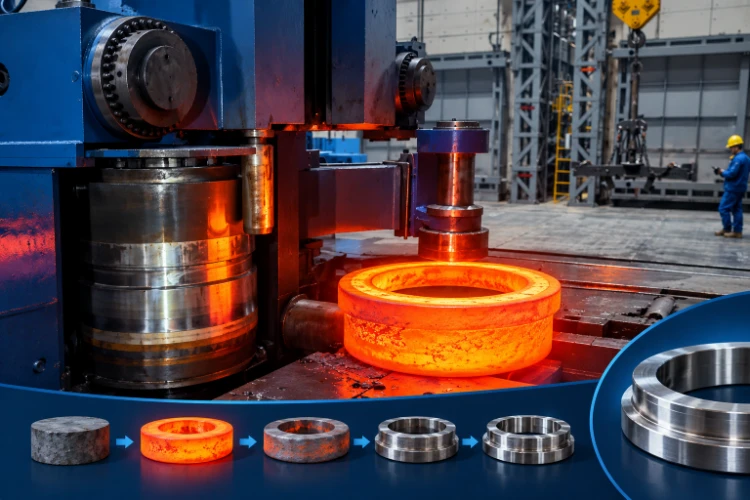
Manufacturers rarely complain about having too little metal. More often, we remove too much of it. That is where near-net-shape ring rolling becomes especially valuable. By forming the ring closer to its final geometry, we can reduce excess material before machining even begins.
For us, this is more than a cost-saving idea. It is a practical approach to producing high-value seamless rolled rings with better material utilization. The process can also support consistent geometry, favorable grain flow, and reliable mechanical performance.
The basic idea sounds simple: start closer to the final shape and machine less afterward. In reality, the engineering requires careful control of geometry, temperature, deformation, tooling, and process stability. That challenge is exactly why profiled ring rolling deserves closer attention.
Why Near-Net-Shape Forming Matters
Traditional forging often starts with extra material. Manufacturers add this stock because later machining must remove scale, surface irregularities, and dimensional variation. The approach works, but the material removed later can represent a significant part of the original forging.
The Forging Industry Association defines an allowance as material added to ensure that machining can clean up a required surface. In other words, allowance protects the final dimension, but excessive allowance becomes expensive waste.
A near-net-shape strategy changes the starting point. Instead of asking the machinist to remove a large amount of material, we ask the forming process to create more of the required geometry.
Less Excess Material, More Useful Metal
The benefits become easier to understand when we compare the manufacturing chain:
- Conventional route → larger blank → heavy machining → more scrap
- Near-net route → optimized preform → controlled rolling → lighter machining
- Profiled route → geometry formed during deformation → reduced finishing stock
This does not mean machining disappears. It means machining becomes a finishing operation rather than a rescue operation.
For high-value alloys, that difference matters. Stainless steels, nickel alloys, titanium alloys, and other expensive materials can make every kilogram of excess material painful.
The result can be a more cost-effective manufacturing route, especially when the same profile repeats across production batches.
How Profiled Rings Change the Process
A conventional ring may use a relatively simple rectangular cross-section. A profiled ring takes a different approach. Its cross-section can include steps, tapers, ribs, flanges, grooves, or other functional features.
This geometry creates an interesting opportunity. Instead of forming a simple ring and cutting away the profile later, the rolling process can direct material toward the required shape.
Research into profiled ring rolling describes the process as a flexible forming method for producing complex seamless rings with high material utilization. Researchers also highlight the difficulty of controlling metal flow because the deformation remains localized and the geometry becomes more complex.
Directing Metal Flow Into the Profile
Metal does not politely follow our drawings. It follows deformation, temperature, friction, and stress.
Therefore, successful profiling requires deliberate control of material flow. The tooling geometry influences where metal moves, while reduction schedules influence how quickly the cross-section develops.
Several factors deserve attention:
- Starting ring dimensions
- Initial wall thickness
- Profile height and width
- Radial reduction
- Axial reduction
- Roll geometry
- Ring temperature
- Material deformation behavior
- Ring growth rate
- Number of forming passes
The goal remains straightforward: move metal where the finished component needs it.
That sounds obvious. Anyone who has watched a complicated forging process knows it is anything but obvious.
From Forging Blank to Functional Ring
A typical seamless rolled ring forging process begins long before the ring reaches the ring mill. Engineers first examine the finished component and work backward toward a suitable preform.
The process may involve billet preparation, heating, upsetting, piercing, preforming, rolling, heat treatment, inspection, and machining. Each stage affects the next one.
A well-designed preform reduces unnecessary deformation. It also helps the rolling process reach the target dimensions without creating excessive profile distortion.
Process Starting Conditions Matter
The process starting geometry strongly influences the final result. If the starting wall is too thick, the process may consume unnecessary energy and create excess material. If it is too thin, the forming process may struggle to develop the required profile.
Temperature also matters. Hot forming gives the material enough plasticity for substantial deformation, but excessive cooling can change flow behavior during rolling.
For this reason, we prefer to consider the complete process rather than one isolated machine setting.
The important questions include:
- What is the finished geometry?
- Which surfaces require machining?
- How much allowance does each surface need?
- Where should the profile form during rolling?
- How will the material flow?
- Which dimensions require tighter control?
- What inspection method will verify the result?
This approach helps ensure your project stays aligned with its final engineering requirements.
Grain Flow and Structural Integrity
Material savings alone do not explain the importance of rolled rings. The deformation process also affects internal material structure.
During ring rolling, deformation follows the circumferential direction. This creates a characteristic circumferential grain flow that can support demanding mechanical applications.
Research describes favorable grain flow and good surface quality as major advantages of ring rolling. Applications include bearing races, ring gears, aero-engine casings, nuclear components, and connecting flanges.
The Forging Industry Association also documents profiled rolled-ring applications where forging helped create continuous grain flow through the ring profile. One case involved a large swing ring gear for mining equipment.
Strength and Durability Start With Geometry
A well-designed ring profile does more than save machining time. It can help place material where loads actually occur.
Consider a ring with a functional flange or raised section. A conventional blank might require substantial machining to create that feature. Profile rolling can form much of the geometry during the deformation stage.
That can preserve more useful material while supporting the component’s intended strength and durability.
However, we should avoid a common mistake: assuming near-net shape automatically means better performance. The result depends on alloy selection, heat treatment, deformation history, dimensional accuracy, and final inspection.
Near-net shape is a manufacturing strategy, not a magic button.
Where Near-Net-Shape Rings Make Sense
The importance of near-net-shape forgings becomes clearer when the component has expensive material, complex geometry, or significant machining requirements.
Typical applications include:
- Aerospace structural rings
- Aircraft engine components
- Gas turbine rings
- Bearing races
- Gear rings
- Pressure equipment
- Power-generation components
- Mining equipment
- Industrial flanges
- Large rotating components
Profiled seamless rings can be especially useful when the cross-section contains functional features.
Recent research has demonstrated near-net forming of complex aerospace ring components using optimized preforms and closed-die ring rolling. The study reported improved material utilization and substantial microstructural refinement across much of the formed section.
Complex Applications Need Better Process Planning
Finding the right manufacturing route for demanding components may be a challenge. Material grade, geometry, tolerances, production volume, and machining requirements all influence the decision.
For example, a simple carbon-steel flange and a complex aerospace ring should not share the same process assumptions.
The same principle applies to forging ring procurement. Customers should provide accurate specifications for end-use applications, including:
- Material grade
- Finished dimensions
- Required profile
- Heat-treatment condition
- Mechanical requirements
- Machining surfaces
- Dimensional tolerances
- Inspection requirements
- Production quantity
Clear information makes engineering decisions much easier.
How to Reduce Machining Allowance Safely
Reducing allowance sounds attractive, but cutting it unthinkingly creates risk. If the rolled ring misses the required geometry, the machining department may not have enough stock to correct it.
The objective is therefore not the smallest possible allowance. The objective is the smallest practical allowance that still protects the final specification.
Balance Accuracy, Material, and Production Risk
We recommend considering allowance through the entire manufacturing chain.
A useful checklist includes:
- Finished part dimensions
- Expected rolling variation
- Thermal contraction
- Surface scale
- Ovality
- Profile deviation
- Heat-treatment distortion
- Final machining tolerance
- Inspection capability
Modern measurement systems can also help close the loop. Research has explored image processing and thermal imaging for measuring diameter, circularity, and temperature immediately after radial-axial rolling. Such feedback can support closer control of near-net dimensions.
The result is a smarter production cycle: measure, adjust, roll, verify, and refine.
That cycle can help reduce material waste without sacrificing dimensional security.
What Buyers Should Ask Before Ordering
When procuring forgings, ordering becomes part of a new project; buyers should look beyond the purchase price.
A cheaper forging can become expensive if it contains excessive machining stock. Likewise, an aggressive near-net design can create problems if the supplier lacks sufficient process control.
Ask the supplier about:
- Preform design
- Rolling capability
- Profile-forming experience
- Material utilization
- Expected machining allowance
- Dimensional inspection
- Heat-treatment capability
- Process simulation
- Quality documentation
- Traceability
The Forging Industry Association publishes guidance on allowances and tolerances for seamless rolled rings. These references can help buyers establish realistic dimensional expectations before production begins.
Choose the Process, Not Just the Product
When customers compare rolled rings, forged rings, and other forging routes, the best choice depends on the component.
Open die forging remains valuable for many large and straightforward geometries. However, a profiled ring can benefit from controlled rolling when the geometry and production volume justify it.
The key is matching the forming process to the component’s real requirements.
At Shandong Ring Rolling Tech, we believe the discussion should begin with the finished ring rather than the equipment. Once we understand the geometry, material, tolerances, and application, we can work backward toward an appropriate forming strategy.
That is how a ring mill becomes part of a manufacturing solution rather than simply another piece of equipment.
The Future of Near-Net-Shape Ring Production
The direction of ring manufacturing is clear. Manufacturers want higher material utilization, better dimensional control, shorter machining cycles, and stable production.
At the same time, modern applications demand increasingly complex geometries. Research into constrained and profiled ring rolling shows that engineers can push material flow further toward complex cross-sections. Some experimental work has demonstrated major material savings compared with conventional rectangular rolling approaches.
For us, the opportunity is exciting.
Less Waste, More Value
Near-net-shape forming does not simply remove metal from a process. It removes unnecessary steps.
A well-designed process can help:
- Reduce excess material
- Lower machining time
- Improve material utilization
- Preserve favorable grain flow
- Support structural integrity
- Reduce handling
- Improve production consistency
- Make high-value alloys more economical
Ultimately, the best ring is not necessarily the one that leaves the forge looking perfect. It is the one that reaches its final application efficiently, reliably, and with minimal unnecessary work.
That is the real value of seamless rolled ring forgings.
For customers who are finding the right process, the smartest starting point is the finished component. Define the end-use requirements first. Then design the preform, rolling strategy, allowance, inspection plan, and machining route around those requirements.
When those pieces work together, the project stays on track from process start through final delivery.
And that is where near-net-shape ring rolling earns its place: not by eliminating machining, but by making every kilogram of material—and every machining operation—count.