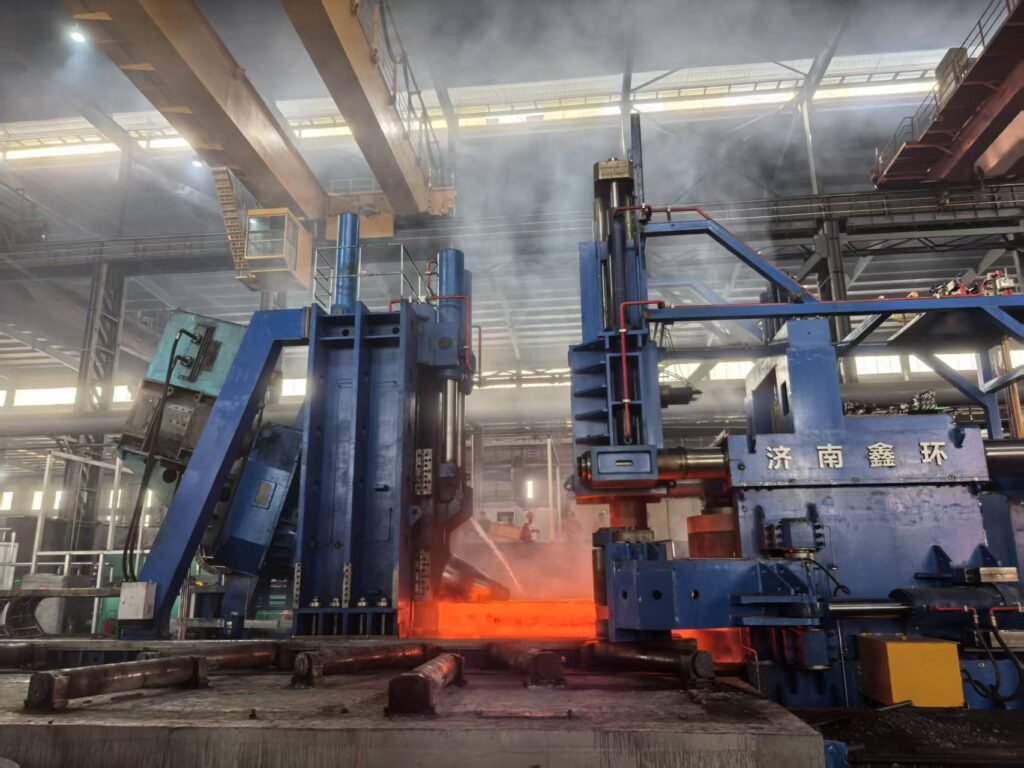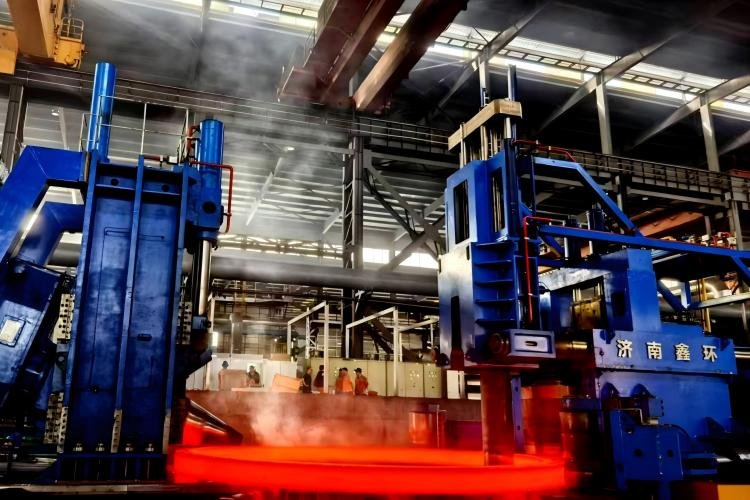
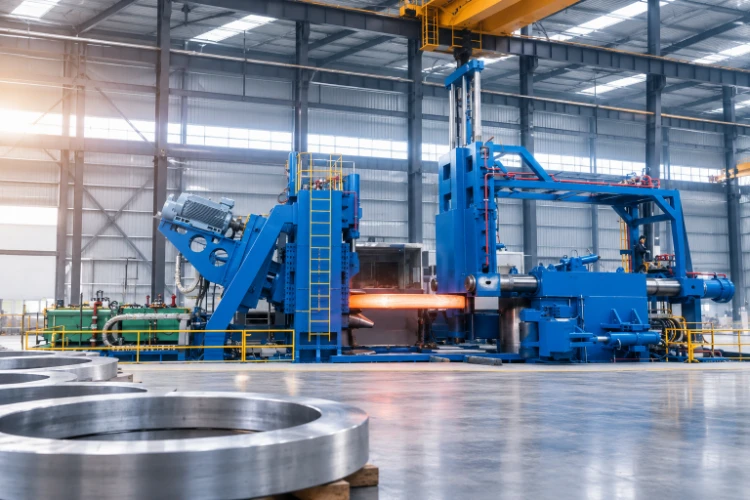
Choosing equipment for large rings is not simply a matter of buying the biggest machine available. We have seen projects where capacity looked impressive on paper but failed against real production requirements. A better approach starts with the ring itself, then works backward through the manufacturing process. In this guide, we explain the key factors we use when evaluating large diameter ring rolling equipment.
Large diameter ring rolling demands more than high forming force. The machine must control diameter, wall thickness, temperature, deformation, and material flow with precision. Meanwhile, production teams must consider machining time, lead times, tooling costs, and future product changes. Get one factor wrong, and the ring can become an expensive steel donut.
Start With Ring Size and Production Goals
The first question should always concern the finished ring. Measure the required outer diameters, wall thickness, height, and target weight before comparing machines. These dimensions determine the working range and forging capability you actually need.
Define the Maximum Ring Diameter
A large diameter ring rolling machine should comfortably exceed your largest planned ring size. Do not select capacity based on today’s biggest order alone. Leave room for future seamless rings, larger forged rings, and changes in customer specifications.
For example, a 13m ring rolling machine targets extremely large components. Such equipment can support applications requiring very large outer diameters and substantial forming capacity. However, the correct choice depends on more than maximum diameter.
Consider these parameters:
- Maximum outside diameter: Ø ___ mm
- Minimum outside diameter: Ø ___ mm
- Maximum ring height: ___ mm
- Maximum wall thickness: ___ mm
- Maximum ring weight: ___ t
- Required forming force: ___ kN
- Expected annual production: ___ rings/year
These numbers give us a much clearer starting point.
Match Capacity With Your Product Mix
Large ring rolling becomes more economical when one machine handles a wide range of products. Therefore, we recommend analyzing your product mix instead of one ideal component. Include current orders, typical projects, and realistic future requirements.
A machine that barely handles one large forged ring may create problems later. Conversely, excessive capacity can increase investment without improving productivity. The sweet spot usually combines sufficient forming capability with useful operating flexibility.
Evaluate Material and Forging Requirements
Material selection strongly affects the forging process. Stainless steel, alloy steel, titanium alloys, and other engineering materials behave differently during deformation. Their flow stress, forging temperature, and deformation resistance can change equipment requirements.
Consider Material Behavior
Before selecting equipment, identify the ring material and its forming characteristics. We recommend reviewing:
- Material grade
- Forging temperature range
- Yield strength
- Deformation resistance
- Required reduction
- Heat-treatment requirements
- Final mechanical properties
For stainless steel, stable temperature control becomes especially important. Poor temperature management can affect dimensional accuracy and grain flow. That can eventually influence strength, durability, and machining performance.
Compare Ring Rolling With Open Die Forging
Large diameter ring forgings often begin with an upsetting or piercing operation. Some projects may also use open die forging before ring rolling. The right route depends on material, dimensions, volume, and required properties.
Ring rolling offers an important advantage: controlled radial expansion. The process shapes metal while developing favorable circumferential grain flow. That makes it attractive for demanding components in energy, aerospace, industrial, and heavy-equipment applications.
For a jet engine, for example, material integrity matters enormously. Every process step must support the final mechanical requirements. The machine therefore needs to fit the complete manufacturing process, not just the rolling stage.
Look Beyond Maximum Force
High forming force sounds impressive, but force alone does not define machine performance. We focus on how accurately the equipment controls the entire forming cycle. Large ring rolling requires stable coordination between rolls, drives, sensors, hydraulics, and control software.
Check Control Accuracy and Stability
During large ring rolling, small errors can become large dimensional problems. The control system should maintain stable rolling conditions throughout the cycle. Important parameters include:
- Radial roll movement
- Axial roll movement
- Ring rotation speed
- Rolling force
- Position accuracy
- Diameter measurement
- Temperature monitoring
- Real-time data collection
A modern control system should also provide useful production records. These records help operators identify process changes and improve repeatability. In our experience, reliable data often proves more valuable than flashy specifications.
Consider Productivity and Machining Time
The machine should support your complete production target. A faster rolling cycle can reduce manufacturing costs, but cycle time is only one part of the equation. Material utilization and machining requirements also influence the final economics.
Reduce Excess Material
Near-net-shape production can reduce the amount of material removed later. A well-controlled rolled ring can approach the required profile more closely. That can reduce machining time, tool wear, material waste, and handling.
For large ring forgings, these savings can become substantial. Removing several millimeters across a large circumference adds up quickly. In other words, a small dimensional improvement can create a surprisingly large cost difference.
Measure the Complete Production Cycle
We suggest evaluating the full route rather than rolling time alone:
- Billet preparation
- Heating
- Upsetting
- Piercing
- Ring rolling
- Heat treatment
- Rough machining
- Inspection
- Finish machining
- Final inspection
This approach reveals the actual bottleneck. Sometimes the rolling machine is not the slowest step. Sometimes machining quietly eats the schedule while everyone blames forging.
Examine Automation and Process Monitoring
Large ring rolling requires close process control. Operators need accurate information while the ring changes shape. Automation can improve consistency while reducing unnecessary manual intervention.
Use Real-Time Process Data
A modern system can monitor diameter, force, position, speed, and other production parameters in real time. Operators can respond earlier when the process moves outside its target window.
Useful monitoring functions may include:
- Automatic diameter measurement
- Rolling force monitoring
- Position feedback
- Alarm management
- Recipe storage
- Production data logging
- Remote diagnostics
- Process trend analysis
These features also support quality documentation. For demanding industries, traceability can matter almost as much as forming capability.
Check Tooling, Maintenance, and Service
Large equipment creates large consequences when downtime occurs. Therefore, service support should become part of the purchasing decision. We recommend asking suppliers about spare parts, installation, commissioning, training, and technical response times.
Calculate Long-Term Operating Costs
The purchase price tells only part of the story. Build a basic lifecycle calculation using:
Total Cost = Equipment + Tooling + Energy + Maintenance + Labor + Downtime
Then compare that figure against expected production output.
Pay particular attention to:
- Drive system efficiency
- Hydraulic consumption
- Roll and tooling life
- Lubrication requirements
- Maintenance intervals
- Spare-part availability
- Operator requirements
- Expected service life
A slightly higher initial investment can make sense when it significantly reduces downtime and operating costs.
Verify Supplier Experience and Customization
A supplier’s experience with large ring rolling matters. Large diameter ring rolling involves engineering challenges that standard equipment cannot always solve. We prefer suppliers who can discuss the actual forming route rather than simply quote machine dimensions.
Ask for Technical Evidence
Before ordering, request information covering:
- Similar machine references
- Maximum demonstrated ring diameter
- Typical ring weights
- Supported materials
- Rolling force and torque
- Control architecture
- Automation functions
- Installation requirements
- Quality-control procedures
- After-sales support
If possible, provide the supplier with your actual ring drawings. A serious manufacturer should evaluate the geometry and process conditions before recommending equipment.
Think About Future Forging Capability
Your machine should support tomorrow’s orders, not only today’s drawings. Markets change, and customers may request different shapes, materials, or dimensions. A wide range of usable sizes gives manufacturers more commercial flexibility.
We believe this point deserves special attention. The best equipment is not always the machine with the largest specification. It is the machine that gives your factory useful capacity without creating unnecessary limitations.
Build a Practical Selection Checklist
Before making the final decision, we recommend scoring each supplier against the same technical criteria. This makes comparisons much easier and removes some of the noise from sales brochures.
Use this checklist:
| Selection Factor | What to Confirm |
|---|---|
| Ring diameter | Maximum and minimum Ø |
| Wall thickness | Required forming range |
| Ring height | Maximum section height |
| Ring weight | Maximum finished weight |
| Material | Steel, stainless steel, alloys, etc. |
| Forming force | Required kN/t |
| Rolling speed | Production-cycle requirements |
| Automation | CNC, sensors, data monitoring |
| Accuracy | Diameter and profile tolerance |
| Tooling | Roll design and expected life |
| Energy | Power and operating consumption |
| Service | Installation, training, spare parts |
| Lead times | Manufacturing and commissioning schedule |
| Future capacity | Expected product expansion |
This table also helps us identify hidden gaps between suppliers.
Conclusion: Choose for the Whole Process
Choosing a large diameter ring rolling machine requires more than checking maximum diameter. We need to consider material, wall thickness, forming force, grain flow, automation, machining time, and future production needs. The best solution connects every stage, from billet preparation to final inspection.
For manufacturers producing large diameter forged rings, rolled ring forgings, and demanding seamless components, process compatibility matters most. A properly matched system can improve material utilization, reduce machining, shorten lead times, and strengthen production consistency.
At Shandong Ring Rolling Tech, we believe equipment selection should begin with the customer’s actual ring. We analyze dimensions, materials, production targets, and the complete forging route before recommending a solution. That approach helps our customers choose practical capacity instead of simply buying impressive numbers.